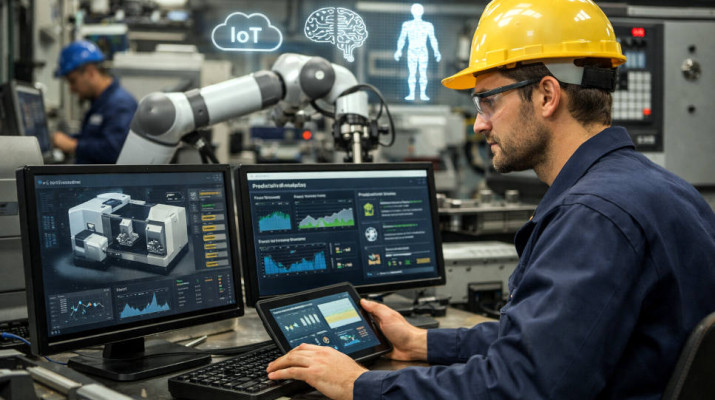
The fourth industrial revolution, referred to as Industry 4.0, is fundamentally transforming the way metal products are manufactured. Intelligent machines, autonomous production lines, cyber-physical systems, and real-time data analytics – all these elements create a new work environment in which the human role is undergoing a profound redefinition. At the center of this transformation stands the operator – a production worker who, for decades, was primarily an executor of physical activities at a lathe, milling machine, or press. Today, they are becoming a supervisor, a diagnostician, and a collaborator of intelligent systems.
This article analyzes how Industry 4.0 changes the operator’s function in the metalworking industry: what competencies are required of them, what technologies they must cooperate with, what challenges production plants face in terms of workforce transformation, and what opportunities this revolution brings for both employees and enterprises.
1. Industry 4.0 – the essence of transformation
1.1. Genesis and definition
The term “Industry 4.0” (German: Industrie 4.0) was formalized in Germany around 2011 as a strategic initiative of the federal government aimed at maintaining the competitiveness of the German manufacturing industry. The term describes the fourth great wave of industrialization – after steam-powered mechanization (Industry 1.0), electrification and mass production (Industry 2.0), and automation using electronics and IT (Industry 3.0).
Industry 4.0 is based on several technological pillars:
- Internet of Things (IoT/IIoT) – a network of sensors and devices exchanging data in real-time
- Cyber-physical systems (CPS) – tight integration of the physical world with the digital one
- Big data and predictive analytics – processing huge sets of production data
- Artificial intelligence and machine learning – algorithms optimizing processes
- Cloud computing – central storage and processing of data
- Collaborative robotics (cobots) – machines working shoulder to shoulder with humans
- Additive manufacturing (3D metal printing) – new methods of prototyping and production
- Augmented and virtual reality (AR/VR) – maintenance and training support
- Digital twin – a virtual representation of machines and processes
1.2. Industry 4.0 and metalworking
The metalworking sector – including turning, milling, grinding, drilling, laser cutting, bending, stamping, or welding – is one of the areas where digital transformation brings particularly tangible results. New generation CNC machines are equipped with dozens of sensors monitoring: temperature, vibration, cutting forces, tool wear, and surface quality. This data goes to analytical systems that optimize machining parameters in real-time.
2. Traditional operator vs. operator 4.0
2.1. Portrait of a traditional machine tool operator
For decades, the machine tool operator – of a lathe, a conventional milling machine, or a press – was primarily a craftsman. Their work required:
- deep knowledge of material properties (steel, aluminum, brass details required different approaches),
- the ability to manually set up and operate the machine,
- the ability to assess surface quality using manual and visual methods,
- experience in solving problems based on the sound of the machine’s operation, the heat of the chips, or the appearance of the surface.
This knowledge was largely tacit (tacit knowledge) – passed from master to apprentice, difficult to codify and transfer. The operator worked in close contact with the machine, and their senses were the primary quality control tool.
2.2. A new role – operator 4.0
The concept of “operator 4.0” (Operator 4.0), popularized by researchers such as Romero et al. (2016), describes a production worker equipped with digital tools who acts in synergy with intelligent systems. Operator 4.0 is not only a machine user – they are a process supervisor, a data analyst, and an active participant in the knowledge management system in the plant.
Key types of operator 4.0 in the context of metalworking:
Operator with a decision support system – uses HMI (Human-Machine Interface) interfaces presenting recommendations regarding machining parameters, tool status, and quality forecasts.
Operator-analyst – interprets process data, identifies trends and anomalies, initiates corrective actions before a failure or defects occur.
Operator-robot collaborator – works alongside cobots during assembly, machine loading/unloading, or ergonomically burdensome activities, focusing on tasks requiring situational assessment and dexterity.
Augmented reality operator – uses AR goggles to visualize maintenance instructions overlaid directly on the machine, which shortens changeover and service time.
Remote operator – monitors and manages multiple machine tools or even an entire production hall from a single station, and in the case of machining centers – potentially remotely.
3. Key technologies shaping the operator’s work
3.1. Modern CNC machining centers and SCADA systems
Contemporary machining centers are equipped with new generation CNC controllers (e.g., Siemens SINUMERIK ONE, Fanuc 30i, Heidenhain TNC 7), which not only execute machining programs but actively monitor the process state. The following are available to the operator:
- adaptive process control – automatic adjustment of feed and rotation speed in response to variable cutting conditions,
- tool wear monitoring – based on motor current, vibrations, and cutting forces, with an automatic tool change call before it breaks,
- digital program management – direct reception of NC programs from the CAM system through the network, eliminating manual data entry.
SCADA (Supervisory Control and Data Acquisition) systems allow the operator to view the status of the entire production line on one screen. Trend charts, alarms, OEE (Overall Equipment Effectiveness) indicators – all this information allows them to make informed decisions without having to physically check each machine.
3.2. IIoT and sensors in metalworking
The Industrial Internet of Things (IIoT) means a dense network of sensors mounted on machines and in processes. In the context of metalworking, typical applications are:
- vibration and acoustic sensors – detecting imbalance, bearing wear, incorrect clamping of the workpiece,
- temperature sensors – control of the cutting zone, coolant heat, motor heating,
- cutting force measurement – tool or fixture dynamometers allowing to assess the edge condition,
- vision systems – in-line inspection, dimensional control using cameras coupled with CV (computer vision) algorithms,
- flow and pressure sensors – monitoring hydraulic systems and coolant systems.
Data from sensors is sent to IIoT platforms (e.g., Siemens MindSphere, PTC ThingWorx, Bosch IoT Suite), where it is aggregated and analyzed. The operator sees the results of this analysis in the form of clear dashboards rather than raw rows of numbers.
3.3. Digital twin
A digital twin (digital twin) is a virtual replica of a machine, process, or an entire plant, synchronized in real-time with its physical counterpart. In metalworking, it allows to:
- simulate new machining processes before starting them on the real machine, which eliminates the risk of collisions and incorrect parameters,
- optimize NC programs in a virtual environment, shortening changeover time,
- predict tool and machine component wear based on virtual fatigue models,
- train operators in a realistic virtual environment without putting the machine at risk.
For the operator, the digital twin becomes a tool for “sampling” changes before they are implemented physically – a revolutionary change compared to the days when testing a new machining program took place directly on expensive material.
3.4. Artificial intelligence and predictive analytics
Machine learning algorithms analyze historical data from machines and identify patterns preceding failures or quality degradation. Examples of applications in metalworking:
- predictive maintenance (PdM) – forecasting the moment of bearing replacement before the machine fails; savings reach 30–40% compared to reactive maintenance,
- optimization of cutting parameters – AI systems suggest optimal combinations of speed, feed, and cutting depth for a specific material and tool,
- anomaly detection – automatic flagging of details deviating from the norm before they reach quality control,
- machining cell optimization – algorithms for planning machining sequences that minimize downtime and energy consumption.
The operator’s role in this ecosystem is to interpret the AI system’s recommendations, verify them in the context of conditions that the machine does not see (e.g., specific properties of a particular batch of material), and make the final decision.
3.5. Collaborative robotics (cobots)
Cobots (e.g., Universal Robots, FANUC CRX, KUKA LBR iiwa) are industrial robots designed to safely cooperate with humans – without physical barriers, with force sensors reacting to contact. In metalworking, cobots take over:
- loading and unloading of machine tools – monotonous, ergonomically burdensome tasks in which the operator was exposed to injuries,
- handling multiple machines simultaneously – one cobot can handle several machine tools while the operator monitors and manages the cell,
- measurements and quality control – positioning details in front of a measuring head or 3D scanner,
- deburring and grinding – repetitive activities requiring constant pressure force.
The operator in such an environment becomes the cobot’s programmer and supervisor, responsible for defining tasks, parameterizing grippers, and monitoring the correctness of operation.
3.6. Augmented reality and remote support
AR systems, such as PTC Vuforia, Scope AR, or Microsoft HoloLens with dedicated industrial applications, provide the operator with information overlaid directly on the field of vision:
- step-by-step changeover instructions – animations showing exactly which bolts to unscrew and in what order to mount the new tooling,
- visualization of sensor data – temperature, vibration, or torque values displayed directly next to a given machine element,
- remote expert support – a specialist from another plant or country sees the same thing as the operator and can make annotations in their field of vision, guiding them through complicated service activities.
Studies indicate that AR systems can shorten the time of performing complex assembly and service activities by up to 30–50%, and the error rate drops dramatically due to eliminating the need to interpret paper instructions.
4. Operator 4.0 competencies
4.1. New competency profile
The transformation of the operator’s role requires a new set of competencies that combines traditional technological knowledge with digital skills. They can be divided into four areas:
Technological competencies (hard):
- knowledge of metal cutting principles, material properties, and tool geometry – this knowledge remains the foundation, although it is supplemented with new technologies,
- ability to operate modern CNC controllers and HMI interfaces,
- basics of ISO programming (G-code) and CAM environments,
- understanding the principles of sensors, industrial networks (e.g., Profinet, EtherCAT), and communication protocols (OPC UA),
- operation of MES (Manufacturing Execution System) and ERP systems in the scope of production reporting.
Analytical competencies:
- ability to interpret process data and dashboards,
- statistical thinking – understanding deviations, trends, process capability indices (Cp, Cpk),
- ability to identify anomalies and their root causes (root cause analysis),
- basics of Lean and Six Sigma methodology.
Soft and adaptive competencies:
- flexibility and openness to technological changes,
- ability to work in multi-functional teams with process engineers, programmers, and IT specialists,
- communication – both with digital systems and with colleagues and superiors,
- independence in making decisions within the defined process parameters.
Safety competencies:
- industrial cybersecurity – awareness of threats, access procedures, responding to incidents,
- physical safety in a human-robot environment,
- emergency procedures for automated lines.
4.2. Deskilling or upskilling?
There is an important debate around the impact of automation on workers. A pessimistic scenario assumes deskilling – the degradation of skills when the machine takes over more and more tasks and the human becomes only an alarm supervisor. An optimistic one points to upskilling – equipping the employee with higher-order competencies that make their work more valuable and satisfying.
In metalworking practice, both phenomena are observed. On the one hand, simple turning or milling operations on standard CNC machines can be increasingly easily automated. On the other hand – handling flexible machining cells, programming cobots, analyzing quality data, or optimizing processes require competencies that were not previously expected of a manual worker.
The key is the active policy of enterprises that invest in the development of employees, not just in machines.
5. Challenges of transformation – production plant perspective
5.1. Competency gap
One of the biggest challenges of the Polish and European metal industry is the competency gap (skills gap). Older, experienced operators possess invaluable technological knowledge but often have difficulty adapting to digital interfaces. Younger employees are digitally proficient but lack an understanding of machining processes.
Solutions used by leading plants:
- tandem programs – pairing experienced operators with younger employees in a formal knowledge transfer,
- digital knowledge repositories – video recordings, knowledge bases, expert systems codifying tacit knowledge,
- blended training – a combination of stationary training, e-learning, and CNC simulators.
5.2. Change management and employee resistance
The implementation of Industry 4.0 technology often encounters resistance from employees – fear of layoffs, fear of excessive surveillance (tracking performance in real-time), or simply reluctance to change proven habits.
Effective change management requires:
- transparent communication – employees must understand why changes are being implemented and how they will affect their role,
- inclusion of operators in the implementation process – their practical knowledge is invaluable when designing new stations and interfaces,
- job guarantees – where possible, a commitment to retraining instead of reduction,
- showing benefits – lighter physical work, lower risk of accidents, higher qualifications.
5.3. Ergonomics and safety in the new environment
The Industry 4.0 environment brings new ergonomic challenges. The operator spends more time at screens, which creates a risk of excessive strain on the eyes and the musculoskeletal system. At the same time, physical work with loading or handling heavy elements is taken over by robots and cobots, which reduces the risk of strain injuries.
New threats are:
- information overload – too many alarms and indicators can lead to “alarm fatigue,” i.e., desensitization to warnings,
- safety in human-robot collaboration zones – despite advanced cobot safety systems, it is necessary to follow new procedures and regularly audit collaboration zones,
- cyber threats – machines connected to the network become a potential target for hacker attacks, which requires employee awareness.
5.4. Infrastructure and system integration
The implementation of Industry 4.0 in metalworking requires significant infrastructure investments: Wi-Fi or fiber optic industrial network in the hall, edge computing for local data processing, integration of old and new machines (the problem of so-called legacy systems). Operators must be aware of this infrastructure to understand system limitations and respond to possible communication failures.
6. Impact on work organization and plant structure
6.1. From station to cell – from cell to network
The traditional operator was assigned to a specific machine. In Industry 4.0, operators manage machining cells (several machines linked by cobots and transport systems) or even entire flexible production lines. This is a fundamental change in work organization.
Instead of a master-foreman-operator hierarchy, a flatter structure appears in which the operator has direct access to data and can – and sometimes must – independently make operational decisions. Autonomy grows, but so does responsibility.
6.2. Three-shift work and data continuity
One of the key challenges is ensuring information continuity between shifts. In an Industry 4.0 environment, where process parameters, tool status, and order status are constantly updated in the digital system, “electronic shift handover” replaces traditional notebook communication. The operator finishing the shift leaves their digital footprint in the system – which brings both benefits (full process history) and challenges (privacy, responsibility).
6.3. New remuneration models and career paths
Higher qualifications of operators in the 4.0 environment should translate into higher salaries and new career paths. In leading plants, one observes:
- digital specialization – operator-programmer, operator-process data analyst, operator responsible for cobot integration,
- technical path – promotion to the role of process technologist or 4.0 maintenance specialist,
- industry certifications – the increasing importance of certificates in the area of CNC, CAM, as well as industrial cybersecurity.
7. Implementation examples and good practices
7.1. Smart factory in machining – a case study
Leading mechanical plants in Germany, Japan, and Scandinavia have been implementing the concept of a smart factory (smart factory) for several years. Typical elements of such a plant in the metalworking industry:
Tool Condition Monitoring (TCM) systems – piezoelectric sensors in tool holders measure cutting forces and transmit data to a predictive system. The operator receives a signal about the need to replace the tool in advance, eliminating breakages and defects.
Automatic in-line quality control – measuring heads mounted directly in the machine tool or at a station between operations perform measurements of key detail dimensions after each cycle. The results are automatically compared with the CAD model, and deviations generate an alarm for the operator.
Flexible cells with cobots – a Universal Robots UR10 cobot handles three CNC lathes, performing loading/unloading, while the operator programs subsequent production orders in the MES system and monitors OEE indicators on a central dashboard.
7.2. Polish perspective – implementation status
Polish enterprises from the metalworking sector – especially tier-1 and tier-2 suppliers for automotive and aviation – are intensively investing in Industry 4.0 technologies. Industrial clusters in the Silesian, Lesser Poland, Lower Silesian, and Podkarpackie voivodeships bring together companies implementing both advanced CNC machine tools as well as IIoT systems and cobots.
However, the challenge for the Polish SME sector is the entry price for a full digital transformation. For smaller plants, a gradual implementation strategy is more realistic: starting from machine monitoring (relatively cheap sensors and software), through digitalization of quality control, to full cells with cobots.
8. The future of the operator’s role – scenarios and forecasts
8.1. Autonomization vs. human necessity
With the progress of artificial intelligence and robotics, the question arises: will the role of the operator in metalworking not disappear completely? The analysis allows to distinguish several categories of tasks and their susceptibility to automation:
Tasks easy to automate:
- repetitive cutting operations on standardized details,
- loading and unloading in large series,
- basic monitoring of process parameters.
Tasks difficult to automate:
- diagnosing non-standard process problems (e.g., vibrations resulting from specific properties of a batch of material),
- adaptation to new, unit orders and prototypes,
- interaction with the customer and engineers in the field of interpreting drawing requirements,
- supervision of the entire system in exceptional and emergency situations,
- ethical decisions and responsibility for quality.
The expert consensus indicates that in the perspective of 10–15 years, the operator will not disappear, but their role will become more cognitive than manual. The number of operators needed to handle the same number of machines will decrease, but the remaining ones will be better paid and perform more valuable work.
8.2. Industry 5.0 on the horizon
Parallel to the discussion about Industry 4.0, the concept of Industry 5.0 appears, promoted by the European Commission since 2021. Industry 5.0 emphasizes three values: human-centric, sustainable, and resilient.
In the context of the operator, this means a return to the central role of the human – not as cheap labor replaced by robots, but as a key participant in the production system whom technology serves, rather than replaces. Ergonomics, worker well-being, ethical supervision of AI – these are the topics of Industry 5.0 that are already shaping a new approach to designing workstations in metalworking.
9. Recommendations for enterprises and institutions
9.1. For production plants
The transformation of the operator’s role towards the 4.0 model requires a thoughtful strategy from enterprises:
- Conducting a competency audit – understanding the current state of knowledge and skills of the operating staff as a starting point for planning training.
- Gradual implementation of technology – avoiding a “big bang” in favor of evolutionary introduction of subsequent layers of digitalization.
- Designing workstations with the participation of operators – ergonomics, intuitiveness of interfaces, and safety should be shaped together with end users.
- Investment in training and retraining – treating training costs as an investment rather than an expense, with programs adapted to different generations of employees.
- Building an organizational culture based on data – encouraging operators to actively use process data rather than just reporting to the system.
9.2. For the education and training system
- Updating the programs of vocational schools and technical colleges – including basics of IIoT, CAM, data analysis, and cobot programming in mechanical education.
- Competency Centers 4.0 – creating laboratories equipped with real CNC machines, cobots, and IIoT systems at universities and training institutions, available for working operators.
- Industry certifications – standardization of digital skill certificates in metalworking, honored by employers.
- Cooperation of industry with education – dual programs, internships, and consultancy of production plants for schools educating operators.
Summary
Industry 4.0 is not the end of the operator’s role in metalworking – it is its deep transformation. The human remains at the center of modern production, but their value no longer flows solely from physical strength and resistance to monotony. The operator’s new asset becomes the ability to interpret data, make decisions in complex situations, cooperate with intelligent machines, and continuously learn.
It is a difficult transformation – it requires effort from employees, significant investments from enterprises, and systemic support from education and industrial policy. But it also brings deeper benefits: safer workstations, higher qualifications and salaries, less waste of materials and energy, and higher product quality.
The operator 4.0 in the metalworking industry is not a human replaced by a machine – it is a human strengthened by technology, capable of performing work that for decades exceeded the capabilities of both humans and machines acting separately. It is precisely this synergy that is the promise of Industry 4.0 – and a challenge that the metalworking industry must meet.