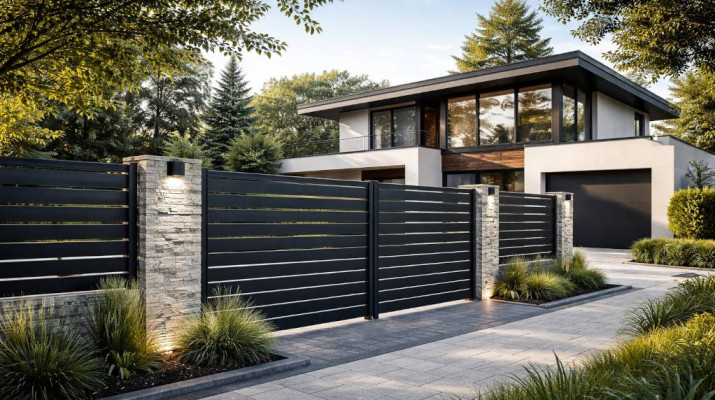
Just a decade or so ago, a fence was simply a boundary. Today, it has become a fully fledged element of landscape architecture, revealing a great deal about the property owner, their taste and their attitude towards the surrounding environment. So, what is changing in the world of fencing in 2026?
1. Living fences are making a strong comeback
Paradoxically, in the age of smart homes and advanced composite materials, one of the hottest trends is a return to nature. Hedges made from hornbeam, beech and privet are once again gaining popularity – but in a new form. Modern living fences are designed with almost surgical precision: plant species are selected according to the local climate, drought resistance and minimal maintenance requirements.
Mixed, multi-species compositions are becoming particularly popular, combining evergreen plants such as holly or cherry laurel with flowering deciduous shrubs. The result? A fence that looks different in every season – and never becomes boring.
2. Corten steel as a design feature
Fences made from Corten steel – with its distinctive “rusted” surface – are no longer reserved for art galleries and modern office buildings. In 2026, they are increasingly finding their way into residential gardens.
Why? Because they are exceptionally durable (the patina layer protects the underlying steel against further corrosion), require virtually no maintenance and look almost like outdoor sculptures. Their warm, rusty tones contrast beautifully with green plants and the grey shades of architectural concrete.
The most popular forms include:
- Slatted panels with regularly cut openings that create an interplay of light and shadow
- Perforated sheets featuring geometric patterns – from simple dots to stylised leaves
- Combinations with wood – for example, vertical cedar boards mounted within steel frames
3. Smart fencing – much more than a gate with a keypad
The concept of the “smart fence” has taken on a whole new meaning in 2026. It is no longer just about a video intercom or an electronic lock controlled via smartphone. Smart fencing systems are now integrated into the entire home ecosystem:
- Motion and vibration sensors built directly into fence posts can detect and warn of attempted intrusion before an intruder even reaches the gate
- AI-powered cameras can distinguish between people, animals and movement caused by the wind, reducing false alarms
- Automatic LED lighting integrated into fence panels responds to the time of day and detected movement
- Video intercoms with facial recognition can grant specific individuals access through the pedestrian gate without requiring a remote control
Modular systems are also becoming increasingly popular. They can be expanded gradually – starting with a simple pedestrian gate equipped with an intercom and eventually developing into a comprehensive perimeter security system.

4. Architectural concrete and gabions – industrial minimalism
The raw aesthetic of concrete is making a bold entrance into residential gardens. Fences made from prefabricated concrete elements – textured, sandblasted or finished to resemble natural slate – respond perfectly to the growing popularity of minimalist residential architecture.
Gabions – steel baskets filled with stone – are also enjoying a revival. Today, however, they are rarely filled with ordinary crushed stone. Popular choices now include:
- River pebbles in contrasting colours
- Grey and rust-coloured slate with regular shapes
- Mixed gabions – with stone in the lower section and wood or metal above
Such fences are heavy, solid, virtually maintenance-free and highly effective at absorbing noise – making them a perfect fit for sustainable building trends.
5. Ecology and sustainability as key selection criteria
Environmental considerations are no longer merely a marketing slogan. More and more property owners are asking manufacturers specific questions about the carbon footprint of materials, FSC certification for wood and the possibility of recycling fencing components at the end of their service life.
As a result, the market is seeing a growing number of solutions such as:
- Composites made from recycled materials (for example, sawdust combined with recycled plastic) that imitate wood while remaining resistant to moisture and pests
- Water-based paints and wood preservatives free from volatile organic compounds
- Water retention systems integrated into concrete posts – rainwater collected during rainfall can supply an automatic hedge irrigation system
6. Colour and personalisation – goodbye to boring grey
Just a decade ago, metal fencing was most commonly painted anthracite or black. In 2026, the colour palette is expanding, although the changes remain subtle and carefully considered.
The dominant colours of the season include:
- Deep bottle green – blending beautifully with garden greenery
- Terracotta and brick tones – complementing clinker façades
- Warm beige and sand – creating a Mediterranean atmosphere when combined with wood
- Graphite with copper accents – for those who appreciate carefully considered details
Embossed and laser-cut patterns on gates are also becoming increasingly popular – ranging from simple geometric motifs to personalised family crests or initials.
7. Regulations and neighbours – boundaries are not just about aesthetics
It is worth remembering that aesthetic trends must coexist with legal requirements. In Poland, local spatial development plans may regulate the maximum height of fencing – often around 2.2 metres along public roads – as well as the types of materials that may be used.
Public awareness of the impact fencing can have on biodiversity is also increasing. New designs increasingly incorporate small openings for hedgehogs and other small animals at the base of fences – a simple feature that costs virtually nothing but can make a significant difference to the local ecosystem.
An investment and a statement
A fence in 2026 is no longer just an expense – it is an investment and a statement. A statement of taste, values and our relationship with the space we live in. Whether we choose a technologically advanced smart security system, raw concrete combined with gabions, or a carefully maintained hornbeam hedge, one thing is certain: the era of putting up just any fence simply “because there has to be one” is well and truly over.